Hemlock Lodge
Created by Sydney Whitaker on Sat Sep 12th, 2026 @ 8:04pm
Hemlock Lodge
Location: beyond Old Quarry Road, west of Renshaw • Function: concealed field residence and temporary operations base
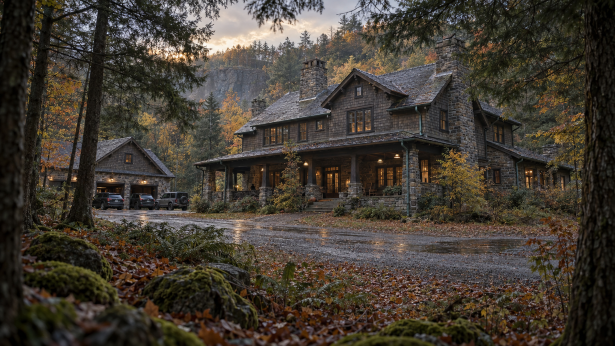
Hemlock Lodge is the specialised unit’s residence during its work in Renshaw. It is large enough to accommodate a team of five or six without forcing them into barracks, but remains a repurposed safe house rather than a permanent regional headquarters. The property provides privacy, secure working space and somewhere its supernatural occupants can lower their guard without exposing themselves to the town.
Origin and public identity
The lodge was built in 1912 as a private country retreat by the industrial family that then controlled Renshaw’s largest foundry and the shallow shale quarry west of town. Constructed for extended stays rather than occasional hunting parties, it contained generous bedrooms, domestic staff quarters and rooms in which the family could entertain business guests beyond public attention.
Regular use ended after the Second World War. The house passed between descendants, a corporate retreat scheme and several holding companies without ever returning fully to life. Public records now place it in the hands of a conservation holding company with a Rochester mailing address. Taxes are paid, boundary notices are renewed and no public visitor centre has ever opened. Most Renshaw residents under fifty have never seen the house; older West Ridge families refer to it as the old Hemlock place and assume it is either empty or used privately during summer.
The organisation acquired the property decades ago as a contingency site following an earlier operation in the wider Finger Lakes. It has been maintained quietly and used only intermittently. Whether that older operation was connected to the threat now drawing the unit to Renshaw remains deliberately unresolved at the beginning of the story.
Landscape and approach
The estate covers roughly eighty wooded acres beyond the former quarry, only a short distance outside the Town of Renshaw boundary but still within Ontario County. The house occupies a shallow natural bowl below the western ridgeline. Dense eastern hemlocks surround the inner grounds, mixed woodland covers the slopes and old quarry spoil interrupts any easy approach from the east. The evergreen canopy conceals the property even after the surrounding hardwoods have lost their leaves.
A narrow private drive branches from Old Quarry Road after its maintained surface has begun to deteriorate. The turning is unmarked apart from a small survey post and is easy to pass at speed. A locked forestry gate farther south controls an overgrown service track, while older footpaths cross wet ground and steep quarry edges before reaching the estate. None provides a convenient accidental route.
Hemlock Lodge is approximately fifteen minutes from Renshaw Police Station in good conditions. Snow, mud or fallen trees can extend that journey considerably. The hollow blocks most sightlines and softens sound, but does not make the occupants careless: exterior lights remain shielded, vehicle movements are controlled and smoke from the chimneys can still betray habitation on a cold clear day.
Supernatural concealment
Natural isolation is reinforced by a layered supernatural influence anchored around the inner property. The effect does not turn the lodge invisible or erase it from memory. Instead, it presses gently upon attention and judgement. An unauthorised visitor is likely to overlook the turning, become certain that the road leads elsewhere, remember a warning about unstable quarry ground or decide that continuing would be trespass without anything worth finding.
Ordinary administrative measures support the effect. The private drive is absent from most navigation services, aerial images identify the parcel as managed woodland and the holding company responds slowly but correctly to legitimate enquiries. Technology provides the dull paperwork; the supernatural influence makes most people accept it without curiosity.
The concealment has limits. It cannot stop a determined person who knows the lodge’s position, prevent a lawful survey, erase tracks or silence a vehicle. Supernatural beings may notice or resist it, and damage to its physical anchor points can weaken the effect. Authorised visitors can be admitted by a resident, although permission does not grant them access to secured parts of the house. These limitations keep the property protected without making it unreachable whenever the story requires danger.
The house
Hemlock Lodge is built from local shale, dark timber and weathered cedar, with a broad covered porch facing a small clearing. It appears lower from the drive than it truly is because the rear of the house descends with the slope. The building is substantial rather than palatial, carrying the weight of an old country residence without resembling a castle transplanted into western New York.
The ground floor contains a mudroom, a large kitchen and pantry, dining room, main sitting room, former library and a smaller bedroom with an adjoining bathroom. The sitting room retains its stone fireplace and enough mismatched furniture for the team to gather without the space feeling formal. The former library can be closed away from the domestic rooms and has become the unit’s briefing and communications room.
Six principal bedrooms occupy the upper floor, supported by four bathrooms added or modernised at different times. The arrangement gives every team member a private room and leaves limited space for a guest, liaison or temporary reinforcement. Smaller attic rooms remain largely in storage. Individual bedrooms can be adapted with blackout shutters, sound insulation, reinforced fittings or environmental controls according to the needs of their occupants, allowing the residence to support different supernatural physiologies without advertising those needs from outside.
Operational facilities
The converted library contains encrypted communications, case displays, secure terminals and a table large enough for joint briefings. It remains recognisably a room in an old house rather than a purpose-built command centre. A locked basement area provides an equipment cage, protected evidence storage, basic medical supplies and one reinforced examination room suitable for a short emergency containment. It is not a permanent cell, laboratory or morgue.
A detached carriage house holds up to four ordinary vehicles and contains a workshop, training space and backup power equipment. Electricity reaches the estate through a buried service, while a private well, septic system and generator allow it to function during outages. Secure radio and satellite connections compensate for unreliable mobile coverage. The systems are robust enough for a field deployment, but a serious forensic examination, long-term prisoner or major casualty must still be transferred elsewhere.
The absence of full headquarters facilities is intentional. Hemlock Lodge gives the unit independence without giving it every answer. Additional rooms, outbuildings and neighbouring land could be developed if Renshaw becomes a permanent operational centre, but that growth should follow earned trust and demonstrated need rather than precede them.
Jurisdiction and access
Because the estate lies just beyond the Town of Renshaw boundary, the RPD is not its primary police service. The Ontario County Sheriff retains countywide authority, while the organisation’s classified federal arrangements discourage routine official attention. The boundary does not place the lodge beyond the law, but it does mean the protagonist normally enters as an invited liaison rather than as an officer exercising town jurisdiction.
That distinction gives the unit control over the first space in which she encounters them privately. It also gives her reason to resent being taken somewhere she cannot easily identify, leave or later locate without assistance. Trust changes the meaning of the journey long before it changes the road itself.
Place in the story
Hemlock Lodge is most important between emergencies. Shared meals, sleepless nights, training, arguments and quiet conversations allow the unit to become people rather than a collection of classified abilities. At first the house belongs entirely to them and the protagonist is a tolerated outsider. Her gradual freedom to arrive, remain and occupy space there can reflect the trust developing between them.
A useful early indication of her dormant nature is that the concealment does not affect her quite as expected. She may notice the hidden turning before she is authorised, retain a clearer sense of the route than an ordinary human should or find her way back without being guided. The unit initially treats this as a security failure. In time, it becomes further evidence that the wards do not recognise her as wholly ordinary.
The lodge is not inherently haunted, corrupted or secretly malevolent. Its tension comes from privacy, old ownership and the people now living inside it. If it eventually becomes a true headquarters, that should happen because the characters have made it one—and because Renshaw has become somewhere they have chosen to defend.
Categories: Town and Recurring Locations